 S3V
NO
S3V
NO
S3V
NO
S3V
NO
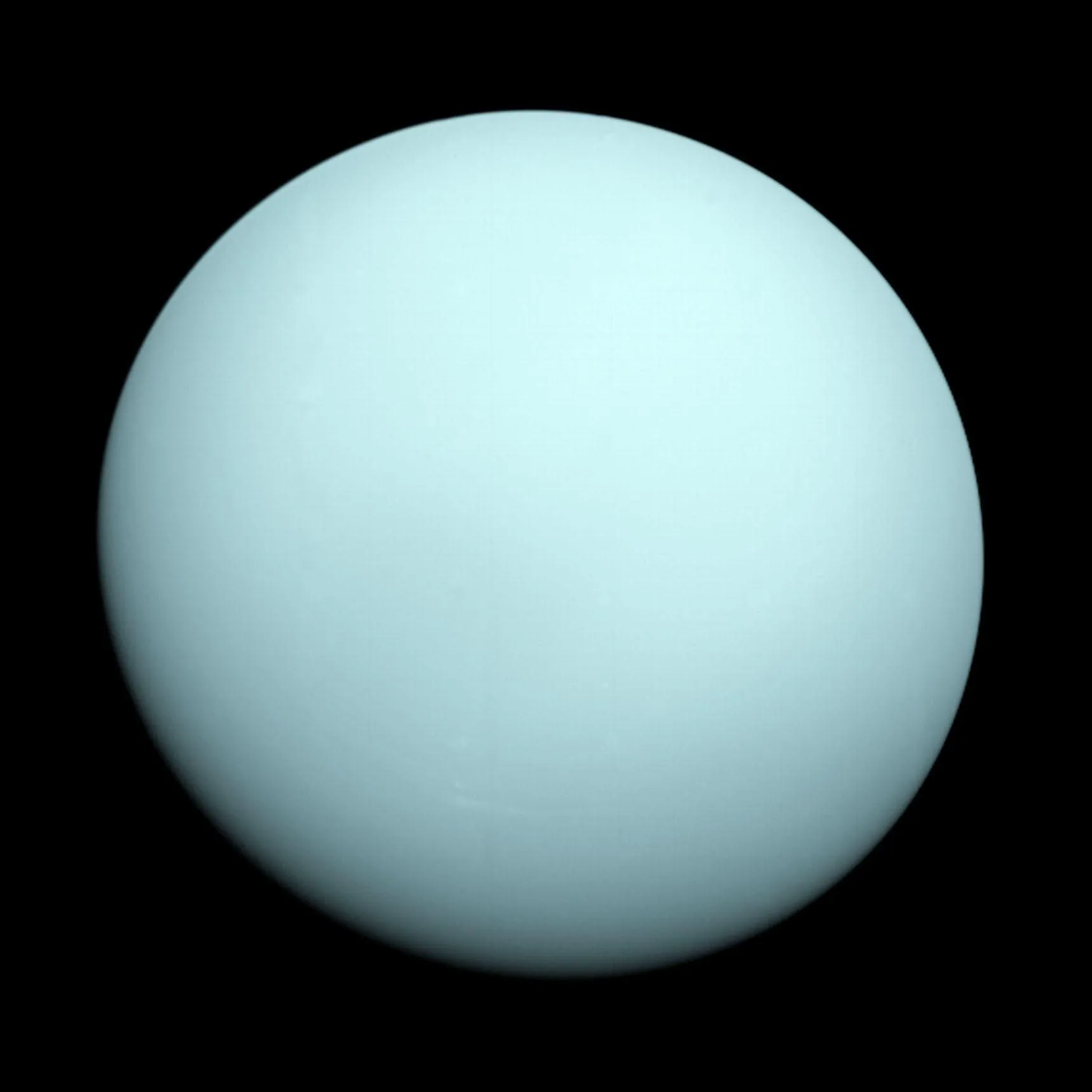
This is not a crop. This is the best photograph anyone has ever taken of Uranus from close range, and it is a blank disc, because the haze sits on top of the weather and hides all of it.
2.9 billion km away · one visit, ever · 5 hours 30 minutes of close data
Every other planet spins roughly upright as it goes round the Sun. Uranus rolls.
At 97.8 degrees the axis is past horizontal, which is why the rings appear to stand vertically rather than lie flat. The usual explanation is a collision with something roughly Earth-sized during formation. The consequence is a 42-year day at each pole: the Sun rises, circles overhead for two decades, then sets for another two.
The lowest atmospheric temperature recorded anywhere in the Solar System, despite Neptune being further out.
Discovered in 1781, so it has completed just under three laps since anyone knew it was there.
All named after characters from Shakespeare and Alexander Pope, and no other planet does this.
Tilted from the rotation axis and not even centred on the planet. Nobody has a settled explanation.
Everything humanity knows from close range about this planet was collected in one afternoon, forty years ago, by a spacecraft that was not designed to go there.
William Herschel, surveying double stars from his garden in Bath, notices something that is not a star. He proposes calling it Georgium Sidus after George III. Nobody outside Britain agrees, and it takes about seventy years for the name Uranus to stick.
Voyager 2 leaves Earth aimed at Jupiter and Saturn. Uranus is not a committed target; it is a possibility that only opens up if the first two encounters go well.
81,500 km, at a relative speed of about 14 km per second. The whole close-range science campaign lasts five and a half hours. Ten new moons, two new rings, and the first look at Miranda.
Challenger breaks apart 73 seconds after launch. The Uranus data is still arriving when it happens, and the encounter effectively disappears from public memory.
No spacecraft has been back. A Uranus orbiter is the top-ranked large mission in the current planetary science priorities, and even if it launched soon it would take over a decade to arrive.
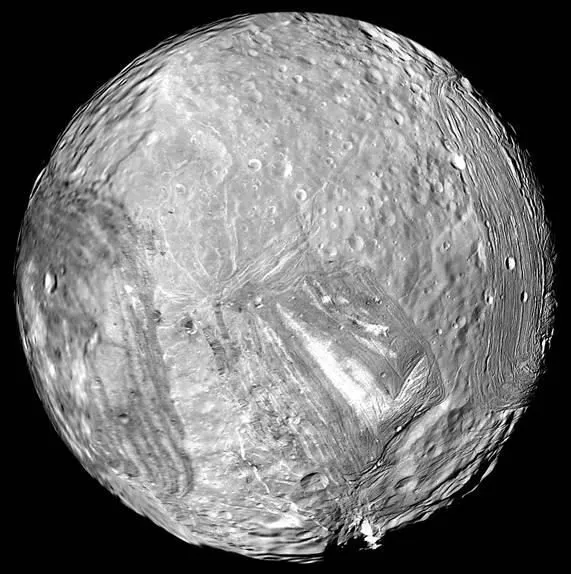
Every other planet takes its moon names from Greek and Roman myth. Herschel's son named the first two after Shakespeare and Pope, and two centuries of astronomers have kept it going.