 S3V
NO
S3V
NO
S3V
NO
S3V
NO
A black hole is not an object. It is a region: the set of places from which no path leads back out, however fast you travel. Everything on this page is about the edge of that region, because the inside never sends anything back.
A spinning hole seen almost edge-on. The band across the middle is the accretion disk. The arc over the top is the same disk's far side, bent over.
Nothing here is a surface. Every boundary on this page is a radius - a distance from the centre at which the geometry does one specific thing. For a hole that is not spinning, all of them are multiples of the same number.
Closer in than this there is no circular orbit at all, at any speed. Matter that crosses it stops orbiting and spirals in. This is why an accretion disk has a hole in the middle that is much wider than the black hole inside it.
The dark disc you see in a photograph, and the only part of any of this that has been imaged. It is two and a half times wider than the hole itself, because light that would have passed the hole cleanly is bent into it instead.
Where light orbits. Not stably: a photon on that circle is one nudge away from spiralling in or flying off, so nothing stays there. Its edge is the bright ring in both photographs below.
The definition. Escape velocity here equals the speed of light, so no path leads back out. Nothing happens locally when you cross it - there is no wall, no flash. It is a one-way boundary you cannot feel.
Where general relativity returns infinite density. Physicists read that as the theory having stopped working rather than as a description of an object, which is why quantum gravity is an open problem and not a footnote.
Drawn from the four multiples in the list above and nothing else - 60 px to one Schwarzschild radius, four concentric circles, one dot. The gap between the shadow at 2.6 and the horizon at 1.0 is the whole reason a photograph of a black hole looks bigger than the black hole: you are seeing light that was bent around it, not the edge itself.
Eight radio observatories, from Hawaii to the South Pole, run as one instrument the size of the Earth. Five petabytes came out of it - far more than any network would carry, so the data flew home as hard drives in cargo holds, and the South Pole disks sat on the ice until the Antarctic winter ended six months later.
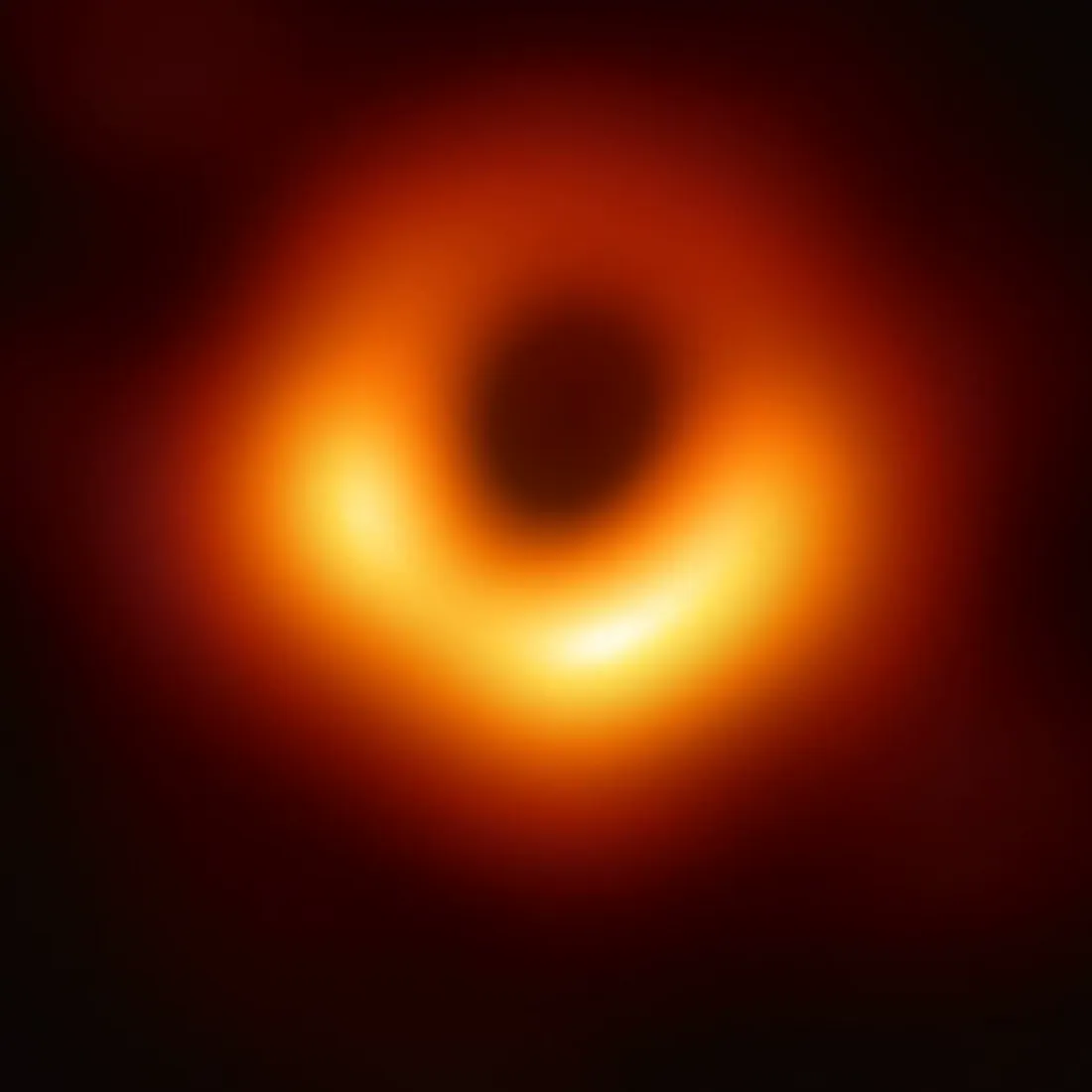
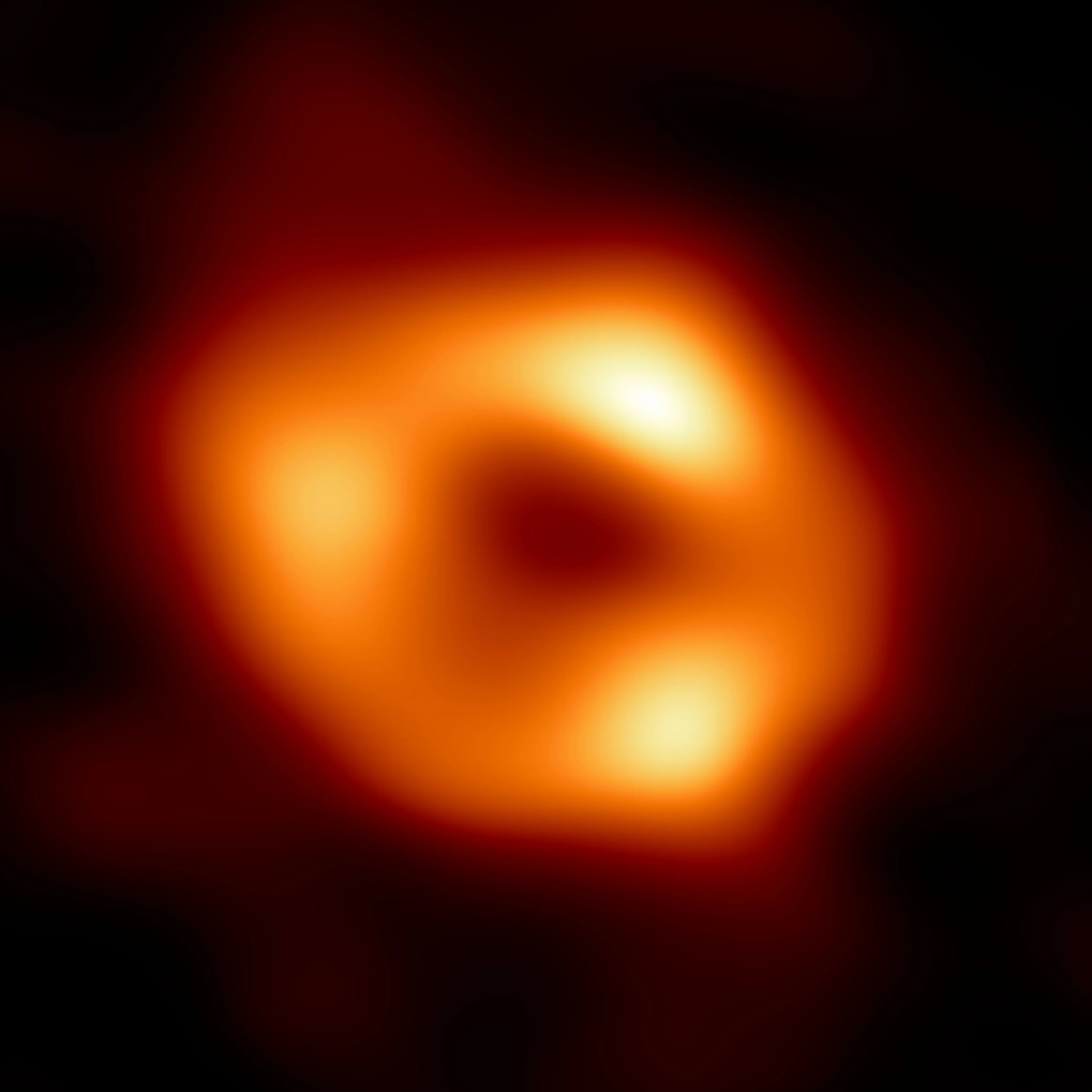
The two look about the same size on the sky, which is a coincidence worth spelling out: M87* is roughly 1,500 times larger than Sagittarius A*, and it is roughly 2,000 times further away. The two factors very nearly cancel. Both shadows come out around fifty millionths of an arcsecond across - the angle a doughnut on the Moon would subtend from a chair on Earth.
Our own was the harder of the two despite being next door. M87* is so large that gas takes days to weeks to travel once around it, so the picture holds still while eight telescopes take it. Sagittarius A* is small enough that the same trip takes minutes. It changed while it was being photographed, and three years of work went into an image that had to admit that.
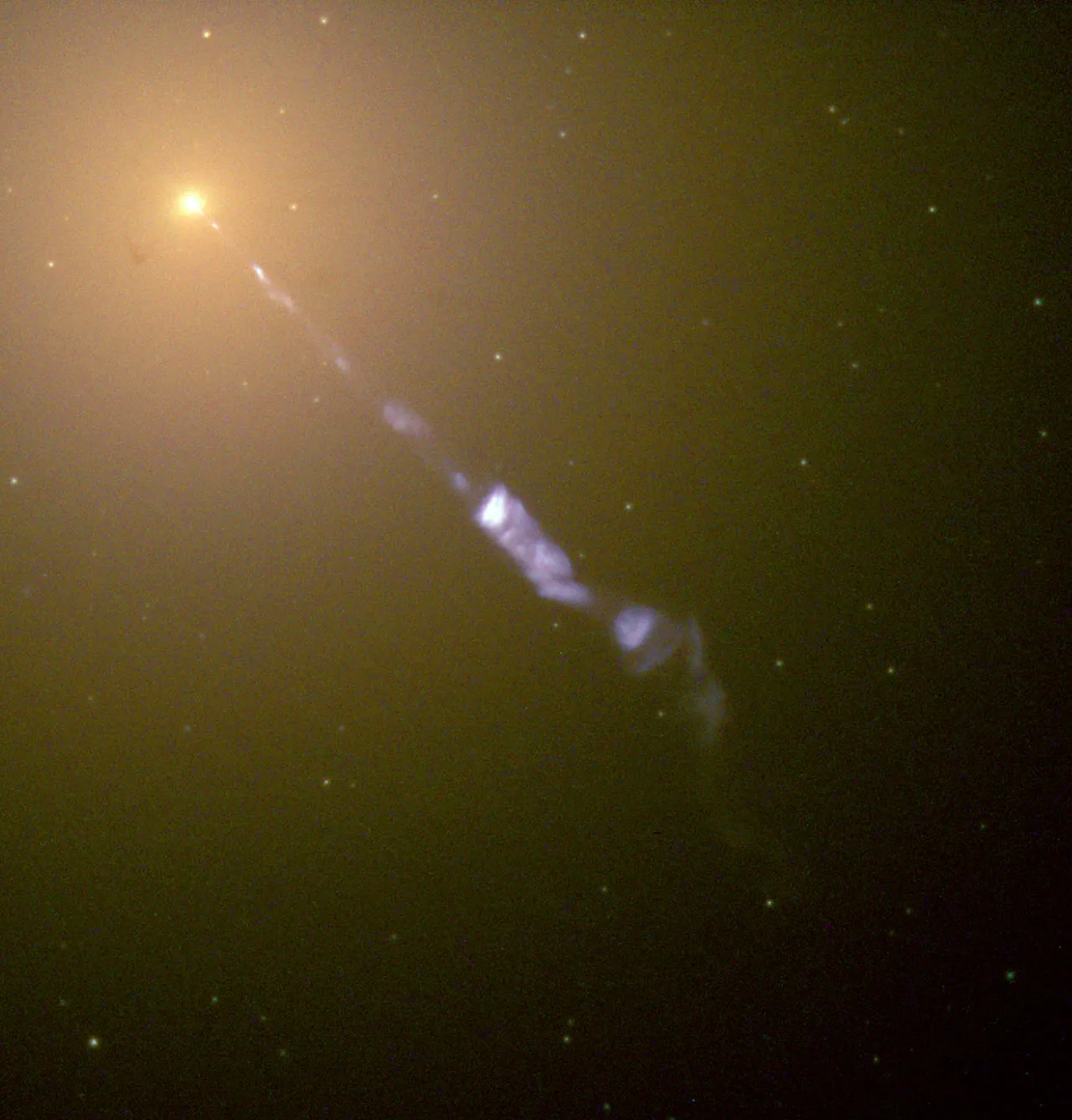
The jet on the left is the older evidence. Heber Curtis noted "a curious straight ray" coming out of M87 in 1918, decades before anyone had a name for what could launch it. It is about 5,000 light years long, and it starts at the object in the photograph above.
EHT Collaboration - M87* and Sagittarius A*. NASA and the Hubble Heritage Team - the M87 jet.
One line of arithmetic covers every black hole ever found. The event horizon radius is 2.95 km multiplied by the mass in solar masses. Not the composition, not the temperature, not the age - there is nothing else in the equation, and it holds across ten orders of magnitude.
| Object | Solar masses | Horizon radius | Distance | Note |
|---|---|---|---|---|
| The Sun | 1 | 2.95 km | 8 light minutes | Hypothetical. It is nowhere near heavy enough to end this way, and will finish as a white dwarf instead. See the Sun. |
| Gaia BH1 | 9.6 | 28 km | 1,560 ly | The nearest one known, found in 2022 by watching an ordinary Sun-like star orbit nothing at all. |
| Cygnus X-1 | 21.2 | 63 km | 7,240 ly | The first object anyone accepted as a black hole. Hawking bet Kip Thorne it was not one, and conceded in 1990. |
| Sagittarius A* | 4,300,000 | 12.7 million km | 26,700 ly | Ours. The entire thing would fit inside Mercury's orbit with room to spare. |
| M87* | 6,500,000,000 | 19.2 billion km | 55 million ly | 128 astronomical units. Neptune orbits at 30, so the solar system would sit inside the horizon four times over. |
Scroll the table sideways
Each panel is drawn to its own scale and the two are not comparable to each other - that is the point. On the left, one pixel is 445,000 km; on the right, one pixel is 148 million km, 331 times coarser. Same equation both times, and the gold circle changes from something that hides inside Mercury's orbit to something that swallows the whole solar system.
Gravity slows clocks. Everywhere, always, including the one on your wrist - it is just that near a black hole the effect stops being a rounding error and becomes the plot.
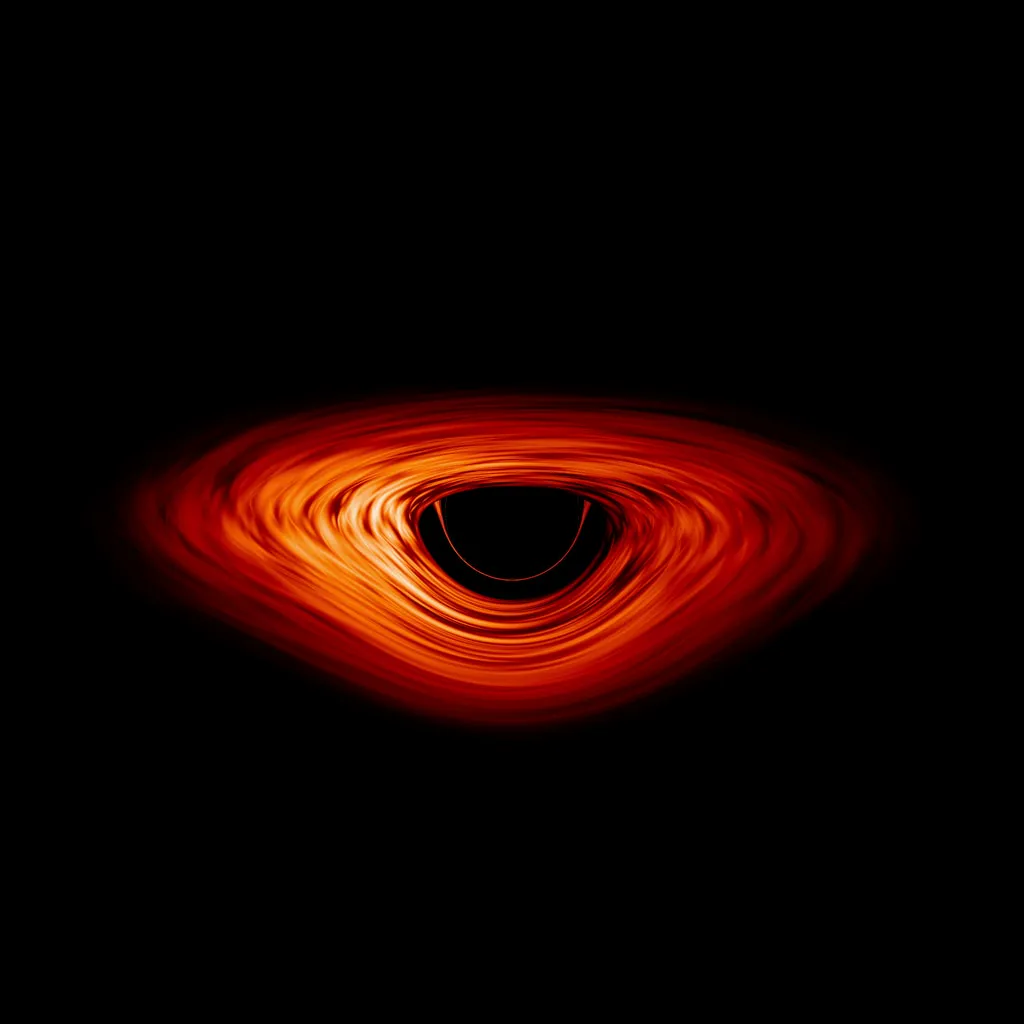
The disk is flat and you are looking at it edge-on, so by rights you should see a line. Instead the far side appears above the shadow and below it at the same time. Light leaving the back of the disk is bent over the top of the hole and delivered to your eye, and the same light is bent under the bottom.
The near side is brighter on one edge for a different reason: that half of the disk is rotating towards you at a large fraction of the speed of light, which beams its light forward. Both photographs in chapter 02 are brighter along one edge for exactly that reason.
The hole in the video at the top of this page is the shape a spinning one makes. That look comes from Interstellar, where Kip Thorne handed the visual effects team the equations rather than a reference image, and their renderer traced bundles of light rays instead of single ones to keep the result free of noise.
The output went into Classical and Quantum Gravity in 2015. A rendering pipeline built to make a film produced a physics paper on the way, which is the rarer direction for that trade.
The same equation, at a scale you use daily: GPS satellites sit higher in Earth's gravity than you do, so their clocks run about 38 microseconds a day fast. Left uncorrected, your position would drift by roughly ten kilometres every day.
Watch someone fall in and you never see them cross. Their light takes longer and longer to climb back out to you, redshifts towards infrared and then radio, dims, and freezes at the edge. The image fades rather than disappears.
Their own clock records a perfectly ordinary, finite time, and the crossing has no landmark. There is no barrier at the horizon and nothing local marks it. The only way to know is that no route back exists any more.
What kills you is not gravity but the difference in gravity between your head and your feet, and that difference is worse for small holes than for large ones. At a stellar-mass hole you come apart thousands of kilometres out. At M87* you would cross the horizon with less strain on you than standing up does.
Hawking showed in 1974 that a black hole radiates, very faintly, and the smaller it is the hotter it glows. A hole the mass of the Sun sits at about sixty billionths of a degree above absolute zero and would take some 1067 years to evaporate. The universe is 1.4 × 10¹⁰ years old, so nothing has finished yet.